Psittacine Beak and Feather Disease (PBFD)
Animal Genetics Inc. offers genetic testing for both type 1 and type 2 Psittacine Circovirus. Animal Genetics also offers Elisa testing to help determine if the bird has developed an immune response to the virus that causes PBFD.
Description:
 The virus causing Psittacine Beak and Feather Disease (PBFD) is a member of the Circoviridae family of viruses. The molecular structure of the genome of the virus is a roughly 2,000 base circular, single-stranded DNA. PBFD virus has a strong resemblance to Porcine Circovirus as well as to a number of plant viruses such as the Banana Bungy virus.
The disease is thought to be specific for psittacines and all psittacine species should be considered susceptible. Parrots known to be particularly affected by PBFD include, but are not limited to, Cockatoos, Macaws, African Grey Parrots, Ringneck Parakeets, Eclectus Parrots, and Lovebirds.
PBFD can cause fatal infections, primarily in young birds. Older birds may overcome the disease with few lasting affects. Some believe that these surviving birds become carriers that are able to shed the disease at a later date. Others believe that a percentage of birds are able to eradicate the disease from their system, leaving them with a natural immunity that can be passed on to their offspring.
The virus that causes PBFD can also affect the liver, brain, and immune system causing diminished resistance to infections. Consequently, premature death usually occurs from secondary bacterial, fungal, parasitic, or viral infections.
Transmission:
Transmission of the virus from one individual to another is primarily through direct contact, inhalation, or ingestion of aerosols, crop-feeding, infected fecal material, and/or feather dust. The virus can also be transmitted via contaminated surfaces such as bird carriers, feeding formula, utensils, food dishes, clothing, and nesting materials. If not destroyed, the viral particles can remain viable in the environment for months, long after the infected bird is gone.
Symptoms:
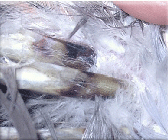
Symptoms include irreversible loss of feathers, shedding of developing feathers, development of abnormal feathers, new pinched feathers, and loss of powder down. Other possible symptoms include overgrown or abnormal beak, as well as symmetrical lesions on the beak and occasionally nails. Immunosuppression, rapid weight loss, and depression are also possible in later stages of the disease.
Secondary viral, fungal, bacterial, or parasitic infections often occur as a result of diminished immunity caused by a PBFD viral infection. Additional symptoms not mentioned above, including elevated white blood cell counts are generally due to secondary infections and may not be directly related to PBFD virus infections.
Diagnosis:
PBFD diagnosis is made by skin biopsy, surgical biopsy of feather and shaft, or PCR testing of blood, swab, and feather samples. Testing for PBFD-specific antibodies can also reveal important information about a possible infection.
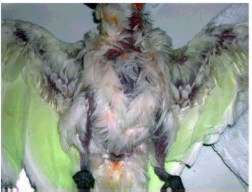
PBFD should be considered in any bird suffering from abnormal feather loss or development. A biopsy of the abnormal feathers including the calimus (shaft) of the feather can be examined for signs of virus. However, since the PBFD virus does not affect all feathers simultaneously this method of evaluating a sample may have a high degree of error. Additionally, birds with PBFD can have normal feathers, so PCR testing is the most effective method available for detecting the virus in birds before feather lesions develop.
Some birds infected with the virus test positive but never show clinical signs. Other birds which test positive may develop an immune response sufficient enough to fight off the infection and test negative after 30-90 days. Therefore, it is recommended to re-test all PBFD positive birds 60-90 days after the initial testing was completed. If the second sample remains positive, the bird should be considered permanently infected and can be expected to show clinical symptoms of the disease.
Sample Type:
Feather (like Bird DNA Sexing).
Submit a Sample for Testing:
- DNA tests (feather) can detect the virus.


.jpeg)



.jpeg)
